About a decade ago, I decided to prioritise reading. Before then, I read only one or two books a year and lacked a daily reading habit. Once reading became a priority, my consumption soared.
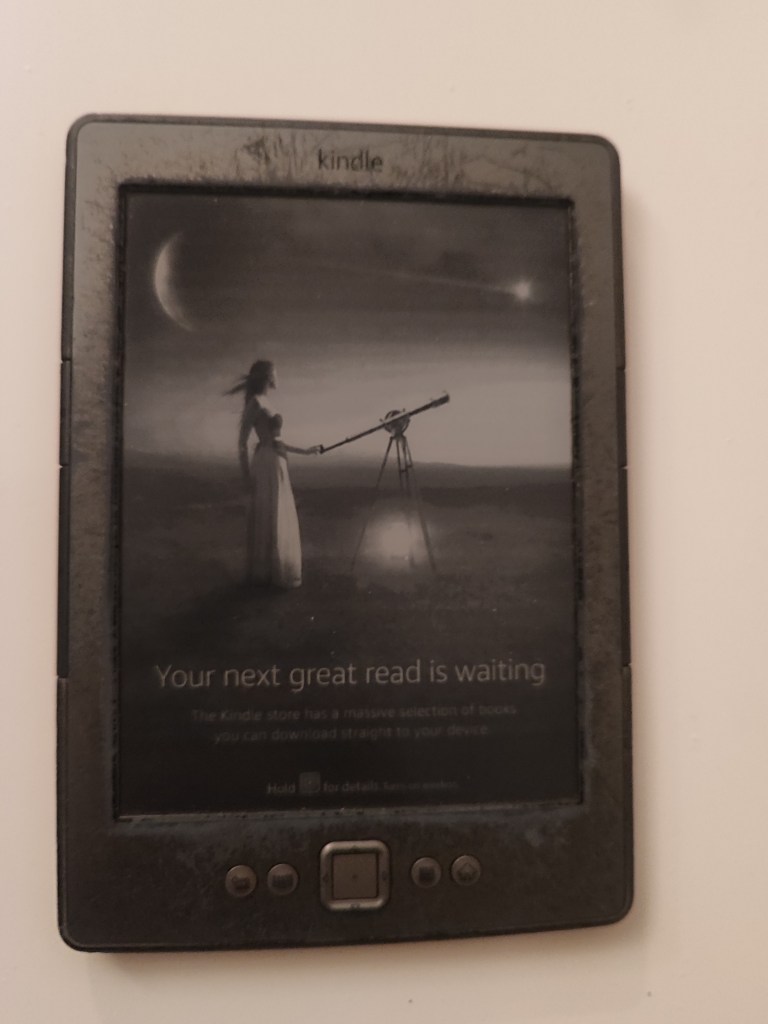
What sparked this change over ten years ago was the Kindle 4 tablet. I’ve always loved books, especially those I chose myself. The Kindle opened up a world of possibilities. Over time, I realised I prefer longer books in physical format, reserving my Kindle for nonfiction or shorter reads.
To satisfy my curiosity, I downloaded my Goodreads data in CSV format and imported it into an SQLite database. This allowed me to analyse my reading habits with specific queries and visualise the results in a Tableau dashboard.
Yearly Reading Trends
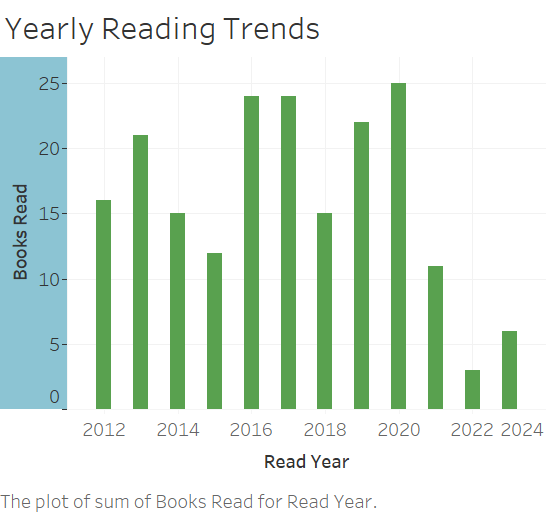
The year I acquired my Kindle, my reading habits took a remarkable turn. I went from reading just one or two books a year to devouring sixteen. It wasn’t solely due to the tablet’s portability, but more about the vast library of books and authors it granted me access to, far beyond what I could find in traditional bookstores.
This trend persisted in the subsequent years, reaching its top in 2020. For obvious reasons, that year provided more time for reading, and I also tackled longer books. As I write this text, I think that another good query would have been to know how many pages I read per year.
After 2020, my reading pace slowed down. In 2021, I began several long books but failed to finish most of them, Solenoid by Cartarescu and The Savage Detectives by Bolaño (Which I restarted and finished this year) are some of them. I vividly recall my day starting at 5:30 in the morning and ending at 7 in the evening, followed by a gym session, leaving me with just 30 minutes of reading time. Perhaps shorter books would have been more feasible. In 2022, after relocating to abroad and focusing on other endeavours, I began picking up the pace once again with the likes of Olaf Stapledon and Bolaño.
Books by Genre
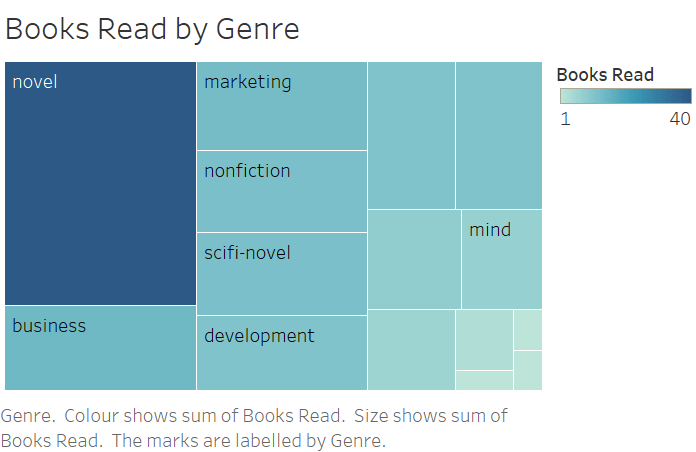
One interesting aspect of my reading journey is the genres I explore. These aren’t the conventional genres defined by Goodreads, but rather the bookshelves I’ve created for my books, resulting in some unique labels. Notably, literature takes the lion’s share, accounting for almost a quarter of my reads. I also have an affection for business books and various types of non-fiction, including works related to the economics of development, psychology, statistics, biography, self-help, and more.
Longest Books
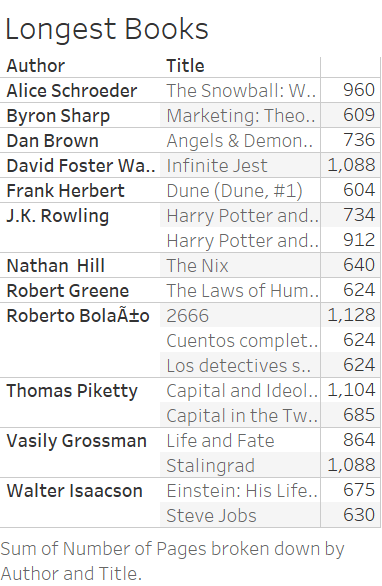
I have a particular fondness for lengthy novels. They take their time to craft engaging stories. I’ve set a query to visualise books with more than 600 pages, and the list includes notable and challenging reads like Infinite Jest. This is the kind of book that sometimes requires breaks to explore other stories, and I even had to seek online assistance to comprehend certain sections. However, its prose remains a source of enjoyment and that I often re-read.
The list also features biographies, another genre cling to. Works by Piketty, my favourite economics author, Bolaño’s 2666 and Vasily Grossman’s Stalingrad series, which would be nearly 2,000 pages if combined, are among the highlights.
Favourite Authors
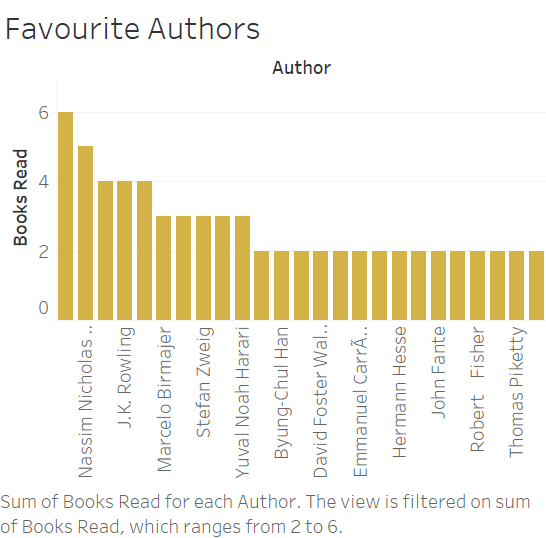
Finally, let’s explore my favourite authors based on the number of their books I’ve devoured. Roberto Bolaño tops the list; his storytelling style has captivated me. I’ve not only devoured his novels but also his short stories and interviews available on YouTube. N.N Taleb is another author I genuinely appreciate, particularly his “Incerto” series.
Other notable mentions in my favourites list include Stefan Zweig and Walter Isaacson. The authors with higher quantities are often there due to series I’ve read, such as the Harry Potter series, Jodorowsky’s L’incal (the sole comic book on my list), and Marcelo Birmajer, an author I enjoyed since my youth. One of his books, “La Máquina que Nunca se Apagaba,” was the first book I read in one sitting, leaving a lasting impression.
Final Thoughts
This exercise allowed me to revisit the moments when I selected my next book and the emotions I experienced with each choice. I recall the challenges of reading “Dune” a long and complex book that I didn’t find particularly enjoyable. It also made me realise that despite my interest in science fiction, it’s not a genre I truly enjoy. The best sci-fi book I’ve read, StarMaker, could easily be considered a philosophy book
Conclusion
This analysis offered a glimpse into my reading journey. If you’re a literature lover, consider adding me to Goodreads and send some recommendations!
 acovilla
Leave a comment